64 transects. 164 km on foot.
That’s how much ground I’ve covered so far—and I’ve learned that fieldwork rarely goes exactly according to plan.
Several landowners had told me I could survey on their land, but then came months of radio silence. Eventually, I had to be honest with myself: I probably wasn’t going to be surveying that particular patch of land.
But what about another patch nearby? Similar habitat. Similar landscape. Close enough to my original transect to still be useful.
Yes. That could work.
So I went back to my trusted sources—the people who had previously helped me with contacts—and started asking about neighboring landowners. In September, I may not have walked exactly where my computer-generated transect was located, but I got pretty darn close. Using this approach, I picked up twelve additional transects.
And there was a bonus: I met some fantastic people and heard some wonderful baboon stories.
You might think people hate baboons but you’d be wrong.
Max Keith had told me about baboons being mantshingilanes—“watchmen” or security guards—because of their remarkable ability to spot intruders from a distance.
That idea goes back at least a century if not more. In 1929, C. L. Harries wrote about the village of Lomondo, where folklore tells of villagers relying on baboons to warn them when enemies were approaching. The baboons would sound the alarm, giving the villagers time to get into position, ambush their enemies, and drive them away. The story goes that the baboons were considered sacred and, even though they ate the villagers’ crops, they were not to be killed.
Naturally, now I want to visit Lomondo and find out whether the mantshingilanes are still held in such high regard.
I got another reminder of the baboon-as-watchman idea this month when I finally received my research permit for Kruger National Park. I walked three transects with two amazing guards. One of them, Origin, accompanied me into a remote part of the park.
It took us 30 minutes of off-road driving to reach the transect. Along the way, we repeatedly crossed a river, winding our way toward an area near the park boundary known for poaching.
Origin told me that when poaching is particularly bad, they patrol the area. And they always know when poachers are around.
The baboons tell them. As Origin put it, “They are always right!”
I love the idea that baboons are acting as security guards. But, of course, the baboons aren’t sounding the alarm for the benefit of people. They’re warning their family members that danger is near.
Family comes first.
A farm manager gave me the word “family” when I asked him to describe baboons in a single word.
I agree.
Baboons are about family—and protecting it.
I have two more transects that I could potentially walk. Nevertheless, after 64 transects, I may just be finished with this part of my data collection.
The next phase is already taking shape. In October, I’ll be attending a conference, giving talks at several South African universities, and encouraging my two Honors students to analyze and write up their own data. I also want to visit Lomondo and other places where people and baboons live in close proximity.
By the end of October, I’ll have just one month left in my Fulbright.
Until then, keep listening for the mantshingilanes in your life.
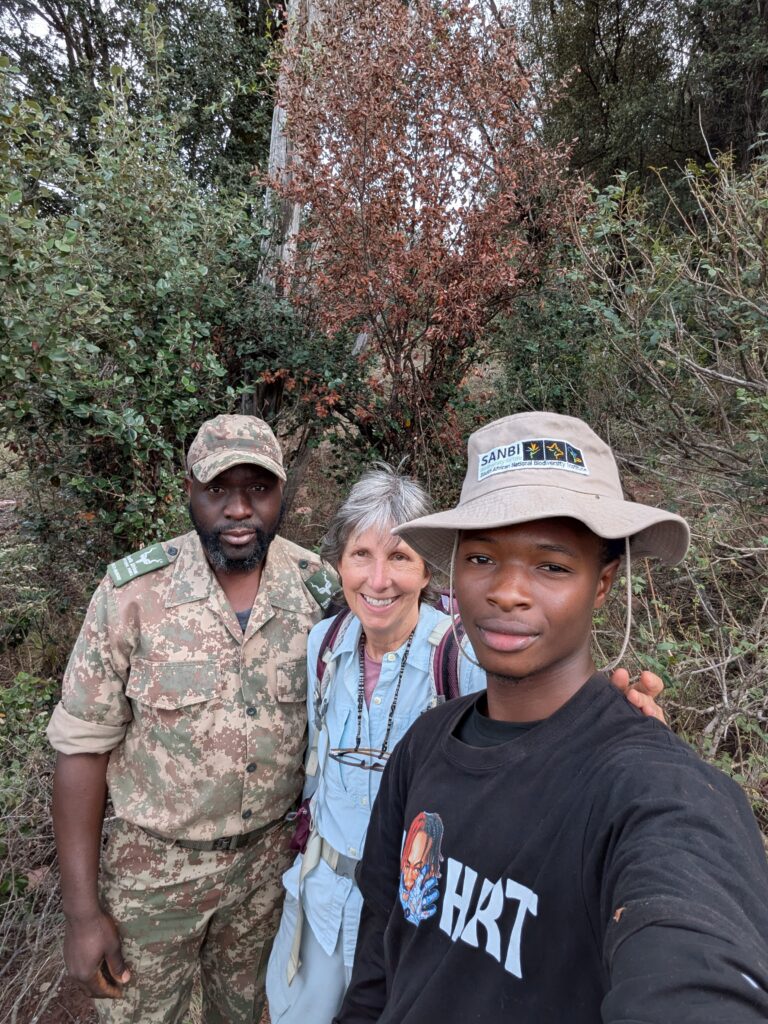
Surveying in Kruger National Park
0 Comments