The dry season arrived in Limpopo, and with it came the start of baboon surveys.
My transects cross private farms, communal lands, and protected areas like national parks and nature reserves. No matter where I survey, permission is essential — but who grants that permission depends entirely on the land. On private property, I ask the landowner. In protected areas, permission comes from South African National Parks (SANParks) or the Limpopo government. On communal lands, permission comes from the local authority: the headman or headwoman.
Before heading into the field, I was given advice on how to approach village leaders: provide enough detail, but not too much. In other words, save the density and distribution spiel for someone else.
Limpopo has three primary indigenous languages — Sepedi, Xitsonga, and Tshivenda, which are spoken by 98% of the population. English is commonly used for business, and many people understand multiple indigenous languages, but misunderstandings are bound to happen.
My field assistant speaks Tshivenda, and while surveying in the northeast corner of the province, he helped locate village leaders, explain my project, and obtain permission to survey. Most encounters were incredibly warm. One headwoman thanked me for visiting her village, wished me luck with my study, and hugged me before we left. Everywhere we went, we were welcomed and told we were free to look for baboons on communal lands.
Then came village number four.
The local language there was Xitsonga. My assistant understood enough to get the general idea, but not every detail. Apparently, he had asked to speak with the chief — a much more important person than we intended to approach. We were instructed to return to the tribunal office the next morning.
Soon after we arrived, several other people joined. The atmosphere immediately felt different. Previous conversations had been “Welcome to our village.” This one became, “How much are you willing to pay?”
If I had been conducting a full-scale survey, I would have happily budgeted for access fees. But I was only scouting the area — essentially having a look and a listen. The requested price was 5,000 rand. After all, I was American, and surely my university had plenty of money.
I tried to explain that neither my university nor I could afford to pay them 5,000 rand.
The long and short of it: I now have one less transect to walk.
Of course, getting to the transects is often its own adventure.
The roads in Limpopo are a mixed bag: smooth tar roads, decent gravel roads, crater-sized potholes, and endless washboard corrugations that make me fear the bakkie (truck) will shake itself apart. Then there are the Kalahari sand roads, which feel remarkably like driving through snow or slush. Lose your momentum, and you’re stuck.
Thankfully, the bakkie I drive has four-wheel drive.
After several days on particularly rough roads, we set out one morning for another transect. The vehicle started normally. Then I hit a bump, and the engine died. It sputtered back to life, only to die again over the next bump. After a few rounds of this, it went completely dead.
I called the mechanic who services the truck. Maybe the battery had died, he suggested. Could we push-start it?
Absolutely not.
So, we waited and waved down passing cars. The first drove right by. The second stopped.
The driver tried starting the bakkie, then asked me to pop the hood.
The moment he said that, I heard my dad’s voice in my head: If you have car trouble, pop the hood and check whether something obvious is wrong.
Sure enough, the battery had rattled loose from all the corrugated roads and disconnected itself completely.
Sigh.
I had immediately assumed I wouldn’t be able to figure out the problem myself. Lesson learned: next time, pop the hood first.
Meanwhile, the good Samaritan’s mother sat smiling proudly in the back seat while her son helped tighten the battery connection. I thanked him profusely, and we continued on our way.
The most fascinating discovery this month, however, has been where baboons sleep.
Back in the Western Cape, the troop I followed slept almost exclusively on rocky outcrops. Baboons in Limpopo do the same — when rocky outcrops are available.
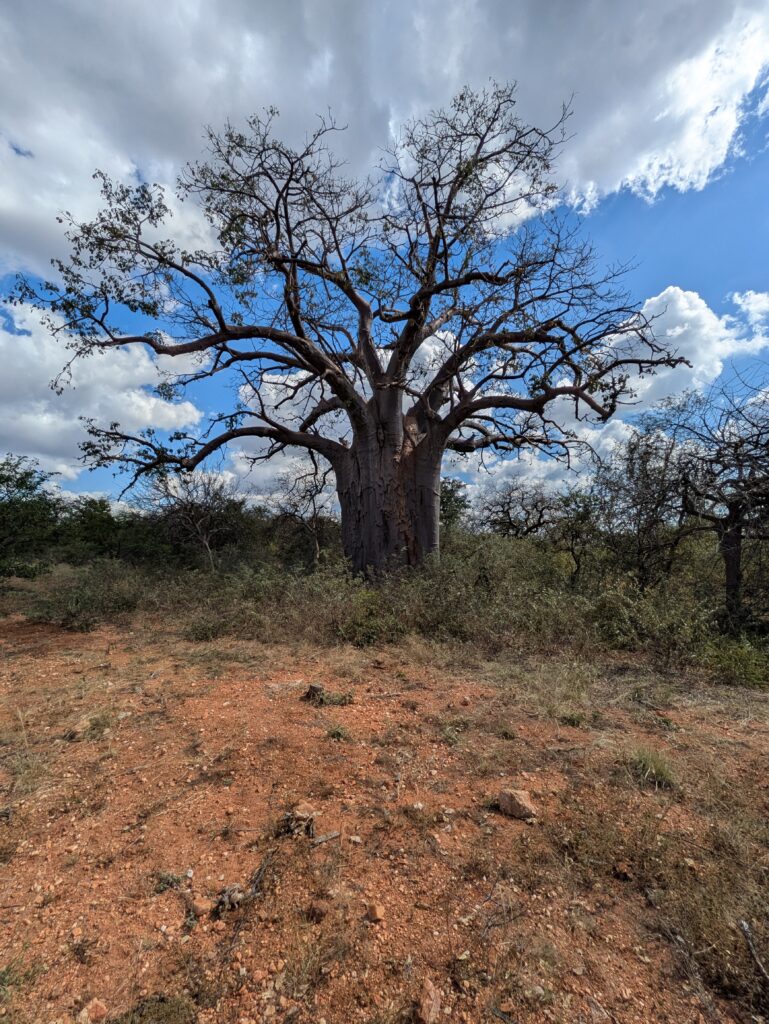
But one property owner, about an hour from where I live, casually informed me that the local baboons sleep in baobab trees.
“Baobabs?”
When he first showed me the trees, I was skeptical. They were massive — enormous trunks stretching skyward with seemingly no way for baboons to climb them.
Then we got closer.
I could smell the accumulated droppings beneath the trees and see excrement stains running down the bark. When I placed my hands on the trunk, I could feel knobs worn smooth from generations of baboon hands and feet using them as climbing holds.
The owner explained that the baboons sometimes leap onto the baobabs from neighboring trees.
Some baobabs they used regularly; others they ignored entirely.
Why? I wondered. Perhaps certain trees were inaccessible to leopards.
Apparently not.
He pointed out fresh leopard claw marks running up one of the trunks.
On other transects, I learned baboons don’t just sleep in baobabs. They also use marula trees, knob thorns, and dense clusters of smaller trees. And where suitable trees don’t exist, they improvise: water towers, airplane hangars, even active mine shafts.
Adaptability at its finest.
This month taught me several things: good communication is key, my dad was right about checking under the hood, and fieldwork rarely goes according to plan. Fortunately, flexibility may be one of the most useful survival skills — for both baboons and researchers.
3 Comments
Brian · May 28, 2026 at 12:30 pm
Love the journal. Thank you for sharing!
The ranch has had 14 blessed inches of rain since beginning of the year, you wouldn’t recognize it.
Flowers, grasses and wildlife are flourishing!
Jenny · May 29, 2026 at 2:59 am
Wow, so interesting. Thanks for sharing Paula.
Beverly · June 2, 2026 at 9:42 pm
How fascinating! The fresh leopard claw marks would definitely give me pause though. What an adventure!