Conservation is often imagined as fieldwork: tracking animals, collecting data, and working in remote landscapes. But one of the most important investments in conservation is much less visible — students.
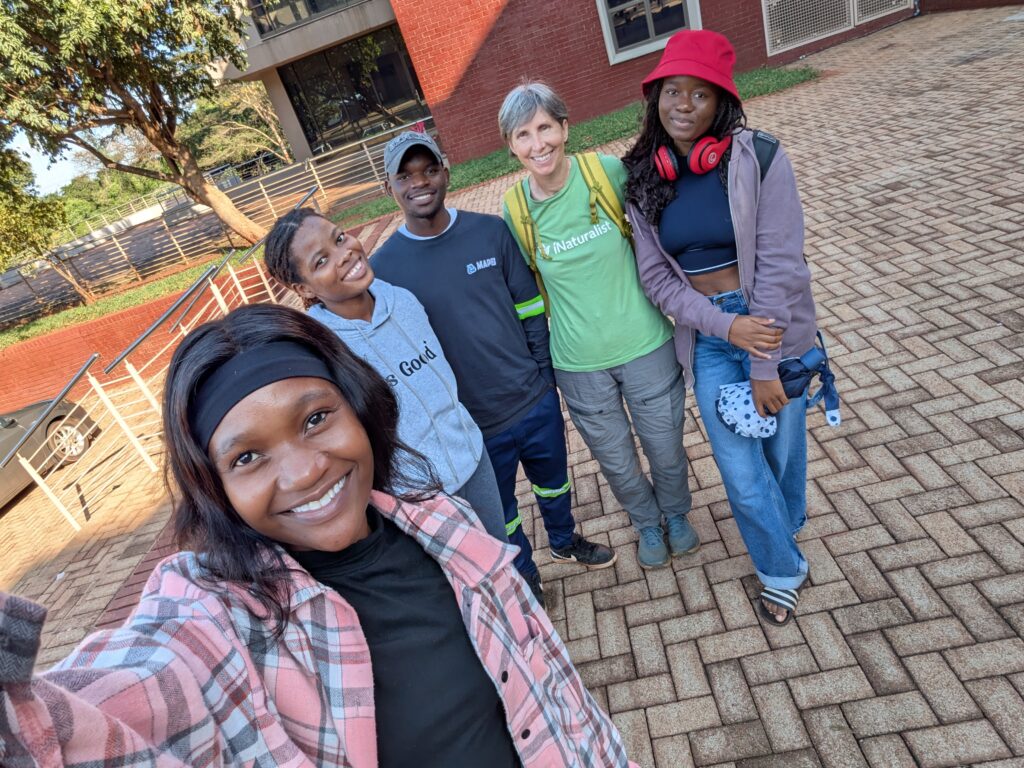
I have the privilege of working with Honors students at the University of Venda (UNIVEN) in Thohoyandou, Limpopo. Although I can’t do fieldwork forever, I can support conservation efforts by helping train the next generation of researchers. This month, I’ll talk about three skills that conservation requires and how UNIVEN students are developing them: communication, confidence, and curiosity.
Communication
Communication can be a struggle. Last month, my two students wrote their research proposals and gave presentations describing the work they planned to do. They learned how to write succinct abstracts, develop hypotheses, create concrete objectives, and explain how they would collect data to test their ideas. This is difficult for anyone, but especially for an undergraduate student. Scientific proposals also require a literature review where students explore what has been done before and properly cite that work.
Once their proposals were written, they embarked on the next phase of the process — communicating those ideas to others. In particular, they needed to present their work to staff and fellow students who would be following their progress. Public speaking comes naturally to a few people, but for most of us it’s the moment when we suddenly mispronounce a word we practiced correctly twenty times before, or when a carefully timed ten-minute presentation suddenly lasts only seven because our 45 speed became 78. We prepared extensively, and I was quite proud of both the presentations they created and the way they communicated their ideas.
Confidence
A part of every presentation is a map of the study area. These maps are created using Geographic Information Systems (GIS). When I first opened a GIS program like ArcGIS or QGIS, my eyes glazed over. I looked at the number of tools in the “toolbox” and immediately felt overwhelmed. I suspect many people feel this way when they first encounter GIS software.
I wanted to give the Honors students the confidence to create their own maps, so I organized a GIS workshop for them. I have the pleasure of working with a fantastic remote sensing specialist, Daan Lichtenberg, who, along with his amazing partner Elina — also a GIS expert and doctoral candidate — came to campus to lead a weekend workshop. Through hands-on exercises and repetition, the students quickly became more comfortable navigating QGIS. Each student needed to create a study map for their project, and Daan and Elina guided them step-by-step through the software so they could create the maps themselves. It was lovely to see the sense of accomplishment the students expressed at the end of the course.
Curiosity
This month was also about sparking curiosity. iNaturalist is a social network for people who love nature. My oldest introduced me to the platform while taking herpetology at the University of Texas, and today it is used by more than four million people worldwide. Every April, iNaturalist organizes the worldwide “City Nature Challenge,” and this year I organized an event at UNIVEN.
My goal was simple: encourage students not just to see plants and animals, but to notice them — to learn their names, recognize their differences, and appreciate the biodiversity surrounding them. The landscape around UNIVEN is fairly degraded, but the students scoured the area, finding incredible insects, marvelous monkeys, and fantastic flowers. To encourage participation (because who doesn’t need encouragement?), I kicked off the event with donuts and offered two prizes — one for the person with the most observations and another for the most species. We had a fabulous turnout. One student recorded 169 observations, another identified 114 species, and together participants logged 2,187 observations representing 856 species.
Conservation is ultimately about people as much as wildlife. Long after I leave Limpopo, I hope these students carry forward the communication skills, confidence, and curiosity that will help foster coexistence, compassion, and sustainability for both people and primates.
1 Comment
Tara · May 11, 2026 at 4:43 am
Voices for Biodiversity and I, its founder, want to congratulate you for the hard work you’re doing. Check out our article about you. “Paula Pebsworth: A Voice for Non-Human Primates” at: https://voicesforbiodiversity.org/articles/being-a-voice-for-non-human-primates-an-interview-with-primatologist. We at Voices for Biodiversity celebrate your work!